
What if the biggest threat to your company's success in 2026 isn't a lack of sales, but the simple timing of your cash flow? It's a common frustration for many entrepreneurs who find themselves waiting weeks for invoices to clear while daily operational expenses continue to mount. Maintaining sufficient working capital is the pulse of any healthy enterprise; yet, the path to securing that liquidity often feels blocked by rigid traditional standards and mountain-sized piles of paperwork.
You likely understand that a profitable business on paper doesn't always translate to accessible cash in the bank. It's stressful to face rejection from banks because of a less than perfect credit score or a lack of recent tax returns. This guide is designed to demystify your liquidity options and show you how to find a funding partner that prioritizes your current momentum over your past setbacks. We'll walk through the essentials of managing your cash cycle and preview how you might qualify for up to $1 million in funding with a same-day decision process.
Key Takeaways
- Identify how a clear understanding of your liquidity serves as a vital safety net for unexpected operational costs.
- Learn to calculate the working capital ratio to determine if your business is operating within the ideal range for stability.
- Discover how to optimize internal processes, such as inventory management and accounts receivable, to unlock trapped cash.
- Explore alternative funding paths that prioritize speed and current performance over traditional credit scores or extensive tax documentation.
- Understand the process for potentially securing up to $1 million in liquidity with same-day funding decisions to meet urgent needs.
Understanding Working Capital: The Heartbeat of Business Operations
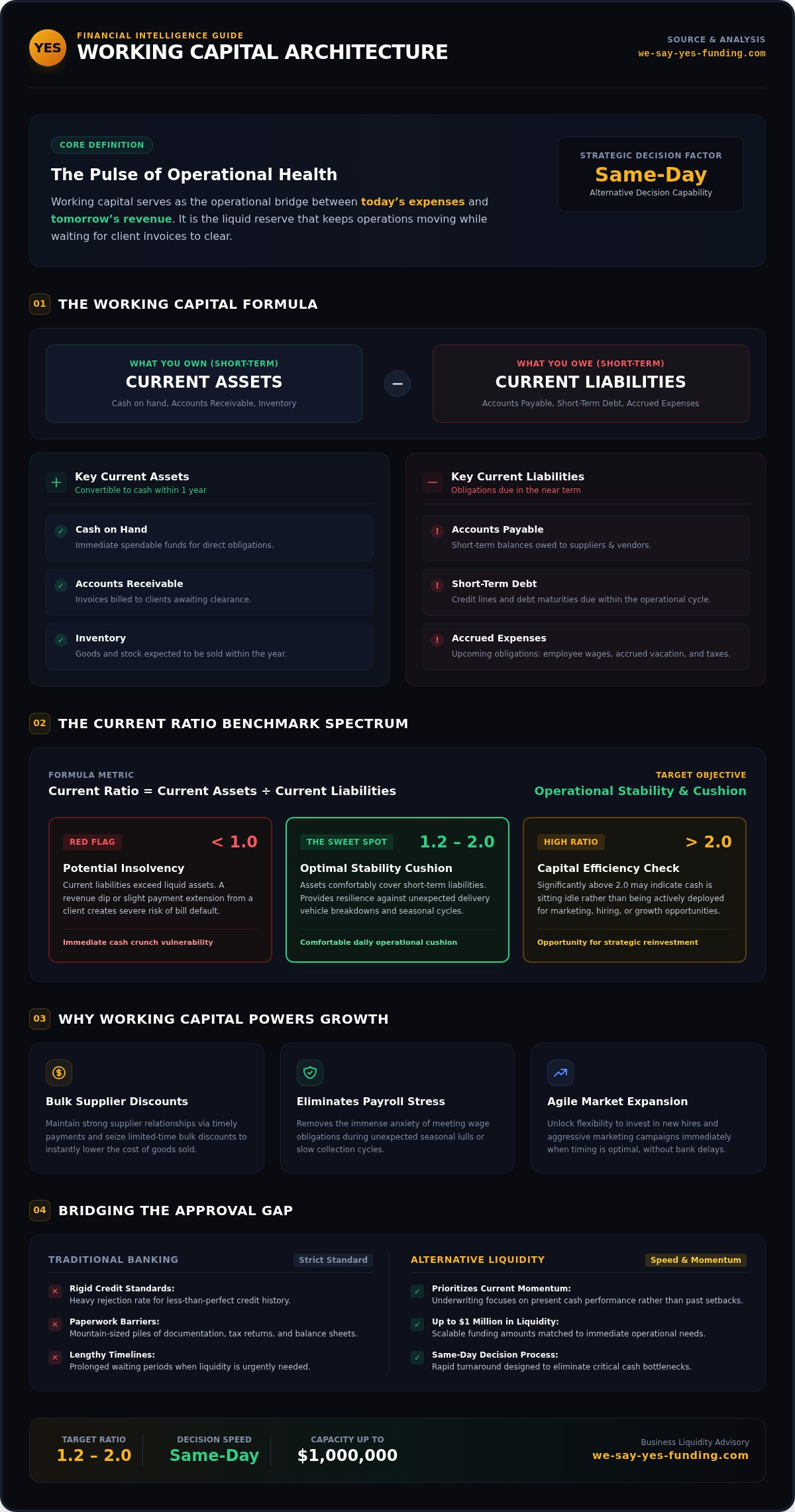
Working capital represents the liquid funds available for your daily business tasks. It's the cash that keeps the lights on and the gears turning while you wait for your customers to pay their bills. Simply put, working capital serves as the operational bridge between today’s expenses and tomorrow’s revenue. Without this liquidity, even a business with record-breaking sales can find itself unable to function when the bills come due.
This financial metric acts as a vital safety net for unexpected expenses and seasonal downturns. If a primary delivery vehicle breaks down or a major client requests a payment extension, your available capital determines whether you can weather the storm or face a full-scale crisis. It's the difference between a minor setback and a permanent closure.
Maintaining positive capital means your current assets exceed your current liabilities. This state suggests a healthy future where you can meet short-term obligations comfortably. Conversely, negative capital is a warning sign that your business might struggle to pay its debts. While some industries operate with low liquidity, a persistent deficit usually indicates that your operational model needs adjustment to avoid insolvency.
Components of Working Capital: Assets and Liabilities
To understand your financial health, you must look at the balance between what you own and what you owe. Current assets include cash on hand, accounts receivable, and inventory that you expect to sell within the next year. On the other side, current liabilities consist of accounts payable, short-term debt, and accrued expenses like taxes or wages. These two categories interact to determine your available 'spendable' cash. You can review a formal working capital calculation and metrics to see how these line items specifically influence your company's liquidity ratios.
Why Working Capital Matters for Growth
Sustainable growth requires more than just a good idea; it requires the ability to seize sudden market opportunities without hesitation. If a supplier offers a limited-time bulk discount, having cash ready allows you to lower your cost of goods sold immediately. Beyond just survival, healthy working capital provides several strategic benefits:
- You can maintain strong relationships with suppliers through consistently timely payments.
- It reduces the immense stress of meeting payroll during slow revenue cycles or seasonal lulls.
- Your business gains the flexibility to invest in marketing or new hires when the timing is right rather than waiting for a bank's permission.
The Working Capital Formula and How to Calculate Your Needs
Knowing your financial standing requires more than a glance at your bank balance. The basic formula for determining your liquidity is simple: subtract your current liabilities from your current assets to find your total working capital. While this dollar amount provides a snapshot of your available funds, many experts also look at the current ratio. This is calculated by dividing those same assets by your liabilities to see how many times over you can cover your short-term debts.
Aim for a ratio between 1.2 and 2.0. A result in this "sweet spot" indicates you have a comfortable cushion for daily operations. However, these targets vary by industry. A retail shop often requires higher liquidity to manage seasonal inventory surges, whereas a consulting firm might operate efficiently with a leaner ratio due to lower overhead costs. While traditional options like SBA 7(a) working capital financing often require extensive documentation of these ratios, the math remains the same for every business owner regardless of the funding path they choose.
Step-by-Step Calculation Guide
To get an accurate picture, start by gathering your most recent balance sheet data. You must categorize your assets based on how quickly they can be converted to cash. Cash and accounts receivable are usually "fast" assets, but inventory might take months to move. Don't forget to look for "hidden" liabilities. These might include accrued vacation pay for employees or upcoming quarterly tax payments that haven't hit your ledger yet. Failing to account for these can lead to a false sense of security and unexpected cash crunches.
Interpreting Your Results
A ratio below 1.0 is a red flag. It indicates potential insolvency, meaning you might not be able to pay your bills if revenue dips even slightly. On the other hand, a ratio significantly higher than 2.0 might suggest you're being too conservative. Holding too much idle cash means you aren't reinvesting in growth opportunities that could scale your business. Use these figures to predict your funding needs for the next quarter. If your projected expenses outpace your current liquidity, it's better to secure a solution early. If your current numbers suggest a shortfall, you may want to explore funding solutions that prioritize speed and don't require years of tax history. Understanding these numbers allows you to move from reactive crisis management to proactive strategic planning.
Traditional Banks vs. Alternative Funding: Navigating the Approval Gap
Securing sufficient working capital through a traditional bank has become an increasingly difficult hurdle for many small business owners. Banks typically operate with rigid risk models that haven't kept pace with the modern economy. They often prioritize long-term historical data and physical collateral over the actual daily performance of your company. Alternative funding prioritizes current revenue and business health over historical credit data.
This shift in the financial landscape means that a business with strong sales but a rocky past might find the doors of a local branch closed. Instead of acting as a partner, many institutions act as gatekeepers, using outdated metrics to determine your future. Alternative funding serves as a transparent bridge, offering a path forward for those who have weathered setbacks but are now seeing consistent growth.
The Reality of Bank Rejection
Bank denials aren't always a reflection of your business's viability. Common reasons for rejection include a low personal credit score, a lack of real estate to use as collateral, or simply operating in an industry the bank deems "high risk." The time cost of these applications is perhaps the most damaging factor. While you wait weeks for a committee to review your file, your operational needs continue to mount. A single rejection can also impact your ability to apply elsewhere, as multiple hard inquiries on your credit report can lower your score further. While some owners spend months researching short-term working capital loans through traditional channels, the high rejection rates often leave them back at square one.
The Rise of Flexible Funding Solutions
By 2026, technology has significantly streamlined the underwriting process for alternative providers. These platforms use advanced algorithms to analyze your real-time bank statements and sales data, rather than relying solely on a three-digit credit score. This shift toward revenue-based evaluation allows for much faster decision-making, often providing answers in hours rather than months. Flexibility is your most valuable asset in a modern funding partnership. It allows you to access liquidity based on your current trajectory, ensuring that a past mistake doesn't prevent you from reaching your next milestone. This supportive approach focuses on finding a way to say "yes" by looking at where your business is going, not just where it's been.
Strategies to Optimize Your Working Capital for Sustainable Growth
Efficiency is just as important as access for managing your business's liquidity. While securing external funds provides a necessary boost, internal optimization ensures those funds work harder for you. Improving your inventory turnover is one of the most effective ways to free up trapped cash. If products sit in a warehouse for months, they represent stagnant working capital that could be better spent on marketing or payroll. By analyzing sales data more closely, you can reduce overstocking and keep your cash flow moving.
Negotiating better terms with your vendors is another powerful, often overlooked tactic. Extending your accounts payable from 30 to 45 days gives you a two-week window where cash remains in your account. Most suppliers are willing to discuss terms if you've been a consistent partner. This extra time allows you to collect from your own customers before you have to pay your bills, creating a more sustainable operational cycle. External funding plays a vital role here, acting as a bridge during those inevitable gaps between your payables and receivables.
Managing Accounts Receivable
Shortening your accounts receivable cycle requires a proactive approach to invoicing. Many businesses find success by implementing early payment discounts, such as a small percentage off if the client pays within ten days. Clear, immediate invoicing processes are also essential; don't wait until the end of the week to send out bills. If your cash flow remains sluggish despite these efforts, you might consider factoring as a way to accelerate your intake. This process turns your unpaid invoices into immediate cash, allowing you to bypass the standard 30 or 60 day wait times.
Controlling Operational Expenses
Keeping operations lean doesn't mean cutting essential services. It involves identifying and eliminating "zombie" subscriptions or inefficient processes that drain your resources without adding value. You should strive for a balance between lean operations and the necessary investments that drive growth. Using working capital to fund efficiency-boosting technology, like automated accounting software or better inventory tracking, often pays for itself by reducing manual errors and saving time. If you find that your current cash reserves aren't quite enough to cover these upgrades, you can apply for bad credit business funding to secure the liquidity you need without the wait.
Securing Working Capital When Speed and Flexibility Matter Most
When your business faces a sudden opportunity or an urgent operational gap, waiting weeks for a traditional institution to review your file isn't just inconvenient; it's a risk to your growth. We Say Yes Funding simplifies the path to operational liquidity by removing the bureaucratic hurdles that often stall progress. By offering access to up to $1 million, we provide the financial fuel necessary for significant expansion or major inventory buys. This level of support ensures that you have the resources to scale when the market demands it, rather than when a bank committee finally reaches a decision.
A bad credit history doesn't have to be the end of your growth story. We recognize that past financial challenges don't always reflect your company's current health or future potential. Our approach focuses on finding a path forward, treating you as a realistic partner rather than just a credit score on a page. This perspective allows us to offer funding solutions that prioritize your current revenue and operational consistency, ensuring that your business can continue to move forward regardless of past setbacks.
Funding Without the Tax Return Burden
Traditional lenders often demand years of tax documentation before they even begin a conversation. We don't require tax returns for the initial application process because we understand that your most recent performance is the best indicator of your current needs. Instead, we focus on your recent bank statements to prove business performance. This streamlined application is designed for busy entrepreneurs who need to spend their time running their companies rather than digging through archives for old paperwork. By looking at your real-time cash flow, we can provide a more accurate and timely evaluation of your working capital requirements.
Getting to 'Yes' Today
The speed of your funding decision can be the deciding factor in whether you secure a new contract or miss a seasonal window. You can expect a transparent and methodical same-day decision process when you work with us. We evaluate businesses based on their current revenue and potential, ensuring that our solutions align with your actual capacity for repayment. This pace allows you to move from application to action without the typical months of waiting. If you're ready to see how a flexible partner can support your next move, you can discover how much working capital your business may qualify for today. We aim to be the bridge that connects your current operations to your long-term goals through a process that is both efficient and thorough.
Fueling Your Business Future with Confidence
Mastering your company's liquidity is a continuous process of calculation and optimization. By understanding the balance between your assets and liabilities, you can move from reactive survival to proactive expansion. It's essential to remember that internal strategies like inventory management work best when paired with flexible external support. While traditional banking hurdles often feel insurmountable, modern alternative solutions provide a transparent bridge to the resources your business deserves.
We specialize in helping entrepreneurs secure working capital based on their current revenue rather than just a credit score. Our streamlined process offers funding up to $1 million without the burden of providing tax returns for the application. We focus on your recent performance to help you navigate operational gaps or seize sudden market opportunities with confidence. If you're ready to move forward, you can Apply Now for a Same-Day Working Capital Decision. Your past setbacks don't have to define your future potential. We're committed to acting as a knowledgeable partner to help you find a sustainable path for your business's growth in 2026 and beyond.
Frequently Asked Questions
What is the difference between traditional bank financing and working capital funding?
Traditional bank options often focus on long-term capital investments and require extensive collateral and high credit scores. Working capital funding is designed specifically for daily operational costs, such as payroll and inventory. Our solutions prioritize your current performance and cash flow rather than just your long-term credit history. This allows for much faster access to liquidity when your timing is critical for growth.
Can I get working capital funding if I have a low credit score?
Yes, you may qualify even with a less than perfect credit history. We specialize in bad credit business funding because we believe your current revenue is a more accurate indicator of your success than a past number. Instead of a hard rejection based on your score, we evaluate the health of your daily deposits and sales to find a path forward for your company.
How much working capital can my business actually qualify for?
Your business may qualify for up to $1 million in funding depending on your current monthly revenue and overall operational health. We look at your consistent sales data to determine a responsible amount that supports your growth without overextending your resources. Because every industry has different needs, we provide a personalized evaluation to ensure the funding amount aligns with your specific goals.
Do I really not need tax returns to apply for funding?
That's correct. We don't require tax returns for the initial application process. We understand that tax documents often represent the past, while your bank statements show how your business is performing today. By focusing on your recent cash flow, we can make a much faster assessment of your needs and provide the liquidity you require without the typical paperwork burden found at traditional institutions.
How fast can I receive a decision on my funding application?
We provide same-day funding decisions to help you meet urgent business needs without delay. Once you submit your bank statements and basic information, our team works quickly to review your file. This speed allows you to secure inventory, manage payroll, or take advantage of a market opportunity while it's still available, rather than waiting weeks for a traditional response that might never come.
What happens if my business has a tax lien or past bankruptcy?
While these factors can make traditional financing difficult, they aren't necessarily a disqualifier for our alternative solutions. We act as a realistic partner and look at the whole picture of your current operations. If your business is currently showing strong, consistent revenue, we may still be able to offer a funding path that helps you move past these historical obstacles and continue your growth journey.
Is collateral required to secure working capital through alternative lenders?
Many alternative funding options don't require you to pledge physical collateral, such as real estate or heavy equipment. Instead, the funding is often based on your future sales or current revenue streams. This approach makes it much easier for service-based or asset-light businesses to access the liquidity they need without risking their personal or business property in the same way traditional lending models might require.
What is considered a healthy working capital ratio in 2026?
A healthy working capital ratio generally falls between 1.2 and 2.0. This range suggests that you have enough current assets to cover your short-term liabilities comfortably while still maintaining enough cash to reinvest in growth. If your ratio is lower, it might indicate a need for additional liquidity to avoid a cash crunch. Conversely, a ratio that's too high might mean you're holding idle cash that isn't working for you.