
Why should a strategic tax deduction from two years ago prevent you from growing your business today? It's a common frustration for owners who find that traditional banks prioritize historical paperwork over current performance. With national banks approving as little as 13.5% of small business requests, many high-grossing companies are left searching for better options. If you've felt the anxiety of a bank denial despite having strong monthly deposits, you're not alone. Securing business funding without tax returns is no longer a fringe option; it's a realistic path for modern enterprises that need to move at the speed of the market.
You probably agree that your bank statements tell a much more accurate story of your business health than a static IRS filing. This guide will show you how to secure up to $1 million in working capital by leveraging your actual revenue velocity. We'll explore how modern underwriting uses real-time cash flow analysis to provide same-day funding decisions, even for those with less-than-perfect credit. We'll walk through the specific requirements for revenue-based options and show you how to bridge your cash flow gaps without the grueling 90-day wait of a traditional bank cycle.
Key Takeaways
- Understand why aggressive tax write-offs often lead to bank denials and how to shift the focus back to your actual gross revenue.
- Learn the specific steps to secure business funding without tax returns by using recent bank statements to demonstrate your operational health.
- Discover how to access up to $1 million in working capital loans with same-day decisions, even if you have been turned away due to a poor credit score.
- Identify the minimal documentation requirements needed to bypass the months-long wait times associated with traditional financial institutions.
- Gain a clear roadmap for partnering with alternative funders who prioritize your current business velocity over historical IRS filings.
The Tax Return Hurdle: Why Traditional Business Funding Stalls
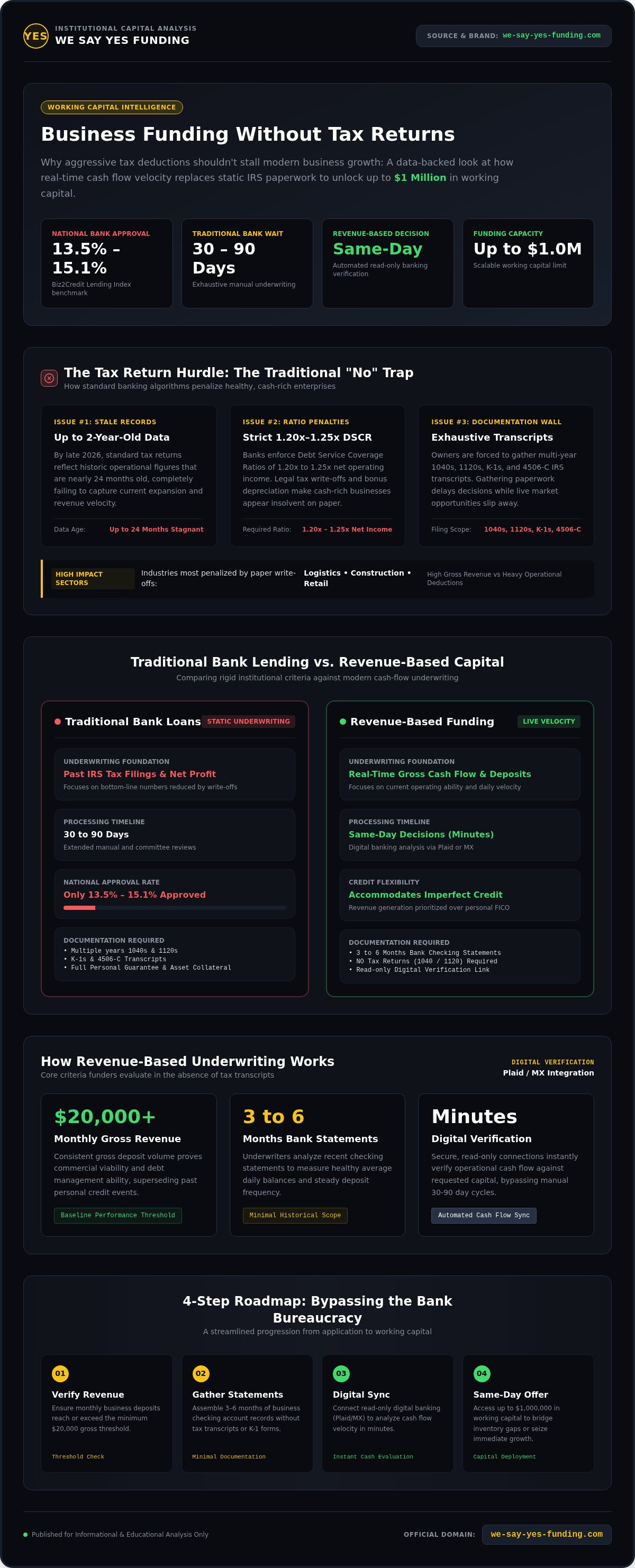
Traditional banks view tax returns as the gold standard for risk assessment. They primarily use these documents to calculate your Debt Service Coverage Ratio (DSCR), which typically requires a 1.20x to 1.25x net operating income relative to debt service. While this helps a bank feel secure, it often creates a "No" trap for healthy businesses. These filings are historical records that reflect where your company was, not where it's going today. This reliance on the past is the primary reason why many owners now seek business funding without tax returns to maintain their momentum.
The Problem with Historic Data in 2026
By the time you apply for funding in late 2026, your most recent tax return might be based on performance data that's nearly two years old. For a fast-growing company, this information is essentially irrelevant. Furthermore, small business owners and their CPAs naturally leverage legal tax write-offs and bonus depreciation to minimize taxable profit. While this is a sound strategy for tax season, it can make a cash-rich business look insolvent on paper. Industries like logistics, construction, and retail are often penalized the most, as their high gross revenues are offset by significant operational deductions that traditional underwriting software views as a lack of stability.
When Paperwork Becomes a Barrier to Growth
The sheer volume of documentation required by traditional institutions acts as a barrier to entry. Gathering years of IRS filings, K-1s, and 4506-C transcripts takes time that busy owners simply don't have. While you wait for a bank's manual review process, which can take anywhere from 30 to 90 days, your urgent need for working capital doesn't stop. You might miss out on bulk inventory discounts or lose a lucrative new contract because you couldn't secure the necessary funds in time.
The statistics reflect this struggle. According to the Biz2Credit Small Business Lending Index, large national banks approve only about 13.5% to 15.1% of applications. In contrast, alternative models prioritize your current performance. Modern business funding without tax returns focuses on your real-time bank deposits and daily cash velocity. It's a shift toward a more realistic partnership where your current ability to generate revenue carries more weight than a static document from a previous tax year. This approach allows for a streamlined experience that matches the pace of modern commerce.
How Business Funding Without Tax Returns Works
Modern funding has shifted away from stagnant paperwork and toward real-time performance. When you seek business funding without tax returns, you're engaging in a revenue-centric evaluation. Instead of auditing your 1040s or 1120s, underwriters analyze your recent bank statements to understand your company's actual cash velocity. This method provides a clear picture of your ability to manage debt based on your current gross deposits and daily balances. Unlike the exhaustive documentation required for SBA 7(a) loans, which often involves years of personal and corporate filings, this approach focuses on the present.
Revenue-Based Underwriting Explained
How does a funder determine your eligibility without a tax transcript? They look at the consistency of your revenue. Underwriters typically review three to six months of business checking account statements. They look for healthy average daily balances and a steady frequency of deposits. This model is particularly effective for bad credit business funding because it prioritizes your business's ability to generate cash over your personal FICO score. If your company is grossing $20,000 or more per month, your performance speaks louder than a credit report. This allows for a more inclusive path to capital for owners who have faced past financial setbacks but currently run high-performing operations.
The Same-Day Decision Advantage
The speed of this process is driven by secure, read-only digital banking verification. Tools like Plaid or MX allow funders to analyze your cash flow velocity in minutes rather than weeks. Once you submit your application, automated systems verify your operational revenue against your requested amount. This leads to same-day funding decisions, which is critical when you face an immediate need for capital. Whether you're bridging an inventory gap or covering an unexpected operational expense, rapid processing ensures you don't lose time to bureaucracy.
Accessing up to $1 million in working capital becomes a streamlined experience when you remove the tax return hurdle. If you're ready to see how your current revenue translates into capital, you can explore options for bad credit business funding that prioritizes performance over paperwork. This transparency helps you understand your funding capacity quickly, allowing you to focus on growth rather than document collection.
Traditional Loans vs. Alternative Working Capital
Banks operate on a model of exclusion. They look for reasons to say "no" to protect their capital, which results in approval rates that often hover between 13.5% and 15.1% for small employer firms. Alternative funding operates on a model of inclusion, prioritizing your current cash flow velocity. This fundamental difference affects everything from the paperwork you submit to how quickly the capital reaches your account. While a bank focuses on your past liabilities, alternative funders focus on your current ability to generate revenue.
When you apply at a traditional institution, you're often facing a documentation mountain of 20 pages or more. This includes three years of corporate tax returns, personal financial statements, and debt schedules. In contrast, business funding without tax returns typically requires only three to six months of bank statements. This streamlined approach is a hallmark of no-doc business loans and alternative financing, where the focus stays on your real-time performance rather than historical IRS filings. By removing the tax audit from the equation, you can secure up to $1 million in working capital based on your actual bank deposits.
The speed of these processes is equally divergent. A bank cycle can last 30 to 90 days, while alternative providers offer same-day decisions. Additionally, banks usually perform a hard credit inquiry immediately, which can lower your score. Many alternative funders provide initial offers based on a soft pull, protecting your credit while you explore your options. This allows you to see what you qualify for without damaging your financial standing.
The True Cost of a Bank Deny
The "wait-and-fail" cycle is one of the most damaging experiences for a growing company. Spending two months on a bank application only to receive a rejection letter creates a massive opportunity cost. You lose the time you spent gathering documents and the window of opportunity for your project closes. Alternative funding serves as a vital bridge, especially for those seeking bad credit business funding. It provides a path forward when traditional doors are closed, ensuring that a single low credit score doesn't stop your operations or inventory purchases.
Qualification Benchmarks
Traditional qualification rests on high credit scores, significant collateral, and several years of profitable tax returns. Alternative qualification is much more accessible. It generally requires at least six months in business and consistent monthly revenue, usually starting around $10,000 to $20,000. Alternative funding is a performance-first solution that evaluates the current health of your bank account to provide rapid capital. By focusing on your daily deposits and average balances, these partners can offer working capital loans up to $1 million without the rigid constraints of a conventional bank audit.
Steps to Qualify for No-Tax-Return Business Funding
Qualifying for business funding without tax returns is a methodical process that starts with your bank account, not your tax professional. You first need to verify your monthly average revenue to understand your capital capacity. Most funders look for a minimum of $10,000 to $20,000 in monthly gross deposits to consider an application. Knowing your specific goal, whether it's bridging a payroll gap or purchasing bulk inventory, helps you request the right amount without overextending your cash flow. It's about demonstrating that your business has the current strength to handle the capital you're requesting.
Preparing Your Bank Statements
Underwriters use your transaction history to gauge the stability of your business. They generally require three to six months of consecutive statements from a dedicated business bank account. Mixing personal and business expenses can cloud your revenue profile and potentially lower your funding limit. Lenders specifically look for:
- Consistent daily or weekly deposit patterns that show regular activity.
- Healthy average daily balances that can support repayments.
- A lack of non-sufficient funds (NSF) fees or negative balance days.
Eliminating NSFs in the months leading up to your application significantly improves your approval odds. It demonstrates that you can manage the daily or weekly ACH payments common in alternative working capital models. Presenting a clean, organized history of deposits is the most effective way to maximize your potential funding limit. This documentation replaces the need for an IRS audit by proving your real-time ability to generate and manage cash.
Navigating Bad Credit Challenges
The most significant advantage of revenue-centric funding is the flexibility regarding credit history. While a traditional bank might reject an application for a score below 700, alternative partners focus on your cash velocity. If your business generates strong, consistent revenue, it can offset a low personal credit score. This approach is why many owners seek out specialized bad credit business funding options when they need capital quickly.
Transparency is your best asset during the evaluation. If you've had past financial setbacks, addressing them during the application can build trust with your funding partner. This model is designed to look at your current performance as the primary driver of the decision. By showing that your current revenue is stable, you prove your ability to repay even if your credit history isn't perfect. If you have your bank statements ready and want to see your options, you can apply for bad credit business funding to receive a same-day decision.
Secure Up to $1 Million with We Say Yes Funding
We Say Yes Funding operates as a knowledgeable bridge for owners who've been sidelined by traditional bank bureaucracy. While national banks approve a small fraction of small business requests, our model focuses on the high-performing companies that are often overlooked despite strong gross revenue. We provide business funding without tax returns because we believe your recent bank deposits are a more accurate reflection of your company's health than a two-year-old IRS filing. This approach allows us to offer working capital loans up to $1 million, ensuring you have the liquid resources to maintain day-to-day operations or capitalize on sudden growth opportunities.
Momentum is a critical asset in any industry. Waiting 30 to 90 days for a bank decision can stall your progress or cause you to lose a competitive edge. Our streamlined process delivers same-day funding decisions, allowing you to move from application to capital in as little as 24 hours. This speed doesn't come at the expense of professional standards; rather, it's the result of modern, revenue-centric underwriting that values your time as much as your revenue. We act as a realistic partner, focusing on finding a path forward rather than searching for reasons to say no.
Tailored Solutions for Bad Credit
We recognize that a personal credit score doesn't always tell the full story of a business's potential. Our specialization in bad credit business funding means we prioritize your current cash velocity over past financial setbacks. We've seen businesses use $1 million in working capital to secure massive inventory discounts, hire specialized teams for new contracts, or expand into new markets. By focusing on alternative funding mechanisms rather than traditional constraints, we provide a supportive environment for high-performing companies that simply need a flexible partner to scale.
Start Your Application Today
The path to securing capital is designed for clarity and accessibility. You can complete the online application in minutes, providing basic information about your business and its revenue. Once you submit your recent bank statements through our secure portal, our team performs a methodical analysis of your cash flow to determine your maximum funding limit. There are no hidden fees or complex tax audits to navigate. You can get your same-day funding decision now to see exactly how much capital your business qualifies for based on its current performance. We're committed to a transparent partnership that helps you focus on what you do best: growing your company.
Move Your Business Forward with Revenue-First Capital
The traditional banking model often feels designed to hold you back, especially when your tax filings don't reflect your current growth trajectory. By shifting the focus from historical paperwork to real-time performance, you can bypass the bureaucracy that stalls most small business applications. You've learned that business funding without tax returns isn't just a possibility; it's a strategic way to leverage your monthly deposits for immediate expansion. Whether you're managing seasonal shifts or seizing a new contract, your bank statements prove your capacity to grow more accurately than any IRS transcript.
Our team specializes in finding a path forward when other institutions focus on past setbacks. We offer a streamlined experience with same-day funding decisions and a specific focus on providing bad credit business funding. You don't have to let a credit score or a missing tax form stop your momentum. If you're ready to access the capital your revenue has already earned, you can Apply for Working Capital Up to $1 Million Today. We're here to act as a realistic partner in your continued success.
Frequently Asked Questions
Can I really get business funding without providing tax returns?
Yes, you can secure business funding without tax returns by utilizing alternative underwriting models. Instead of looking at historical IRS filings, funders evaluate your current cash flow through recent bank statements. This approach allows businesses to access capital based on their present performance rather than past tax strategies. It's a realistic option for owners who leverage deductions or have high gross revenue that isn't fully reflected on their net income lines.
What is the maximum amount of funding I can receive without tax documents?
We Say Yes Funding provides working capital loans up to $1 million without requiring tax returns for the application process. The specific amount you qualify for depends on your average monthly gross deposits and overall cash flow velocity. By analyzing your last three to six months of business bank statements, underwriters can determine a funding limit that aligns with your company's actual ability to manage and repay the capital.
How does bad credit affect my ability to get working capital?
While traditional banks often reject applications with scores below 700, revenue-based funding models are much more flexible. We specialize in bad credit business funding by prioritizing your current revenue over your personal FICO score. As long as your business demonstrates consistent monthly deposits and healthy daily balances, you can still qualify for significant capital. This focus on performance helps bridge the gap for owners who've faced past financial setbacks.
How fast can I get a decision on my funding application?
You can receive a same-day funding decision once your application and required bank statements are submitted. The use of digital verification technology allows underwriters to analyze your cash flow in hours rather than weeks. This rapid turnaround is designed to support business momentum, ensuring you can address urgent operational needs or inventory gaps without the 30 to 90 day wait times typical of conventional bank cycles.
What documents do I need if I am not providing tax returns?
The primary documentation required for this process is three to six months of consecutive business bank statements. You'll also need to provide basic information about your business, such as your time in operation and your monthly gross revenue. Unlike traditional processes that demand 20 or more pages of financial history, this streamlined requirement focuses on your most recent transaction data to prove your current operational health and repayment capacity.
Is alternative funding more expensive than a traditional bank loan?
Alternative funding options often have different cost structures than traditional bank loans, reflecting the increased speed and accessibility they provide. While interest rates at banks are pegged to the prime rate, alternative funders use factor rates or revenue-based terms. It's helpful to consider the opportunity cost of a bank denial or a 60 day delay versus the immediate benefit of securing capital to fulfill a lucrative contract or purchase bulk inventory.
What industries are eligible for business funding without tax returns?
Most industries that generate consistent monthly revenue are eligible for this type of funding. This includes sectors like construction, logistics, retail, and professional services where cash flow can be high even if taxable profit is low. As long as your business has been operational for at least six months and meets the minimum monthly revenue benchmarks, you can explore business funding without tax returns regardless of your specific industry niche.
Do I need to provide collateral for this type of working capital?
Many alternative working capital options don't require traditional hard collateral like real estate or heavy equipment. Instead, the funding is typically secured by your business's future sales or overall revenue profile. This makes it a flexible choice for service-based businesses or companies that don't own significant physical assets. Underwriters look at your bank deposits as the primary indicator of security rather than requiring you to pledge personal or corporate property.
